E-mail:
Research interests:
I am interested in how the brain controls behavior. Many scientists approach this very large question by starting with perception and asking how the brain builds an internal representation of the world, and how it then uses this representation to guide action. In contrast, I study behavior by starting with a concrete task such as a voluntary movement and asking what parameters of the task the brain must specify and control, and what information from the environment it may employ toward that specification. The goal here is an understanding of brain mechanisms for mediating interaction with the world, not necessarily of mechanisms for representing the world. A research program based on such an approach begins with questions concerning motor control and gradually works its way toward the perceptual systems which guide that control. One could say I'm going backwards through the brain...
Here is my Curriculum Vitae and Google scholar profile.
Some talks available online:
- On our work in the lab: “The neural mechanisms of real-time decisions”
- On brain evolution: “Rethinking Brain Mechanisms in the Light of Evolution”
- Interview on the “Brain Inspired” podcast: [Episode 66: Forward through evolution] [Episode 67: Backward through the brain]
Lab News:
- Our CFI application for large-scale neural recording and behavioral studies in virtual reality environments has been funded for ~$700k.
- The Brain Canada grant (with N. Dancause, B. Ebitz, A. Green, and M. Perich) for building the “Ethological Laboratory” (EthoLab) has been funded for $~900k.
- Our NSERC grant has been renewed until 2027.
- Our CIHR grant has been renewed until 2030.
 Projects:
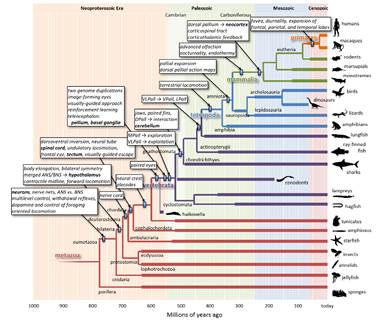
“Phylogenetic
refinement”
In
1973, Dobzhansky famously said that “Nothing in biology makes sense except in
the light of evolution”. I agree. For that reason, I’ve recently started
devoting part of my time to reading about the evolutionary history of the
nervous system, and writing a book about all the things I’ve learned. I’m doing
this chronologically – that is, I read about early multicellular animals first,
then about early chordates, vertebrates, etc. gradually working my way along
the lineage that leads to humans. I believe this has given me a broader
perspective on the brain and behavior, and on everything I do in the lab,
because it has exposed me to some amazing work by people we don’t normally hear
about in systems neuroscience circles. The book will take a long time to finish,
but I summarized some of the key points in a paper published in 2019. That
paper makes a very provocative proposal: that we should consider abandoning
many of the familiar concepts inherited from the history of psychology and
instead resynthesize our conceptual taxonomy according to the history of
evolution. A second paper, with some colleagues, applies this approach to
theories of attention, and a third (in a special issue
on the topic) describes in more detail the specific advances made along the
lineage that produced primates like us.
Cisek, P. (2019) “Resynthesizing behavior through phylogenetic refinement” Attention, Perception, and Psychophysics. 81(7): 2265-2287. [PDF]
Hommel, B., Chapman, C., Cisek, P., Neyedli, H., Song, J-H., and Welsh, T. (2019) “No one knows what attention is” Attention, Perception, and Psychophysics. 81(7): 2288-2303. [PDF]
Cisek, P. (2022) “Evolution of behavioural control from chordates to primates” Philosophical Transactions of the Royal Society B. 377(1844): 20200522. [PDF]
“Affordance
competition hypothesis”
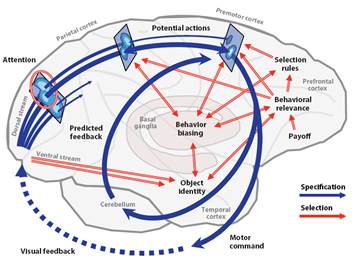 Classical theories in psychology suggest that behavior
consists of serial processes of
computing representations of the world from sensory information, using those representations
to build knowledge and make decisions, and then finally executing motor actions
that implement those decisions. However, these classic concepts are difficult
to reconcile with the growing body of neurophysiological data on decision
processes distributed throughout the sensorimotor system. Instead, we and
others have proposed that the basic functional architecture of behavior is parallel – and that the brain is continuously
using sensory information to specify potential actions available in the world
(“affordances”) while at the same time collecting cues for selecting which one
is most appropriate at a given moment. This very general hypothesis makes a
number of specific predictions, which we are testing through behavioral,
neurophysiological, and computational projects.
Classical theories in psychology suggest that behavior
consists of serial processes of
computing representations of the world from sensory information, using those representations
to build knowledge and make decisions, and then finally executing motor actions
that implement those decisions. However, these classic concepts are difficult
to reconcile with the growing body of neurophysiological data on decision
processes distributed throughout the sensorimotor system. Instead, we and
others have proposed that the basic functional architecture of behavior is parallel – and that the brain is continuously
using sensory information to specify potential actions available in the world
(“affordances”) while at the same time collecting cues for selecting which one
is most appropriate at a given moment. This very general hypothesis makes a
number of specific predictions, which we are testing through behavioral,
neurophysiological, and computational projects.
Cisek, P. (1999) “Beyond the computer metaphor: Behaviour as interaction”. Journal of Consciousness Studies. 6(11-12): 125-142. [PDF]
Cisek, P. (2006) “Integrated neural processes for defining potential actions and deciding between them: A computational model”. Journal of Neuroscience. 26(38): 9761-9770. [PDF] [suppl]
Cisek, P. (2007) “Cortical mechanisms of action selection: The affordance competition hypothesis” Philosophical Transactions of the Royal Society B. 362: 1585-1599. [PDF] [suppl]
Cisek, P. and Kalaska, J.F. (2010) “Neural mechanisms for interacting with a world full of action choices”. Annual Review of Neuroscience. 33: 269-298. [PDF]
Pezzulo, G. and Cisek, P. (2016) “Navigating the affordance landscape: Feedback control as a process model of behavior and cognition”. Trends in Cognitive Sciences. 20(6): 414-424. [PDF]
“Biased competition
in sensorimotor maps”
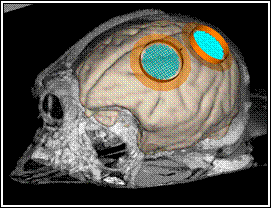
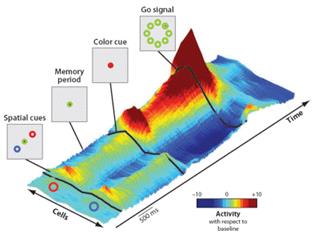 The affordance competition hypothesis
suggests that the brain can represent multiple potential actions in parallel
within the same regions involved in executing those actions during overt
behavior, and these parallel representations compete against each other during
decision-making. This competition is influenced by a variety of biases, such as
reward value and effort, and unfolds within a “sensorimotor map” that reflects
the geometry of the immediate environment. Our work with former student
Alexandre Pastor-Bernier confirmed two key predictions: 1) that reward values
influence activity in premotor cortex, but only when there is a choice to be
made; and 2) that the competition between two very different actions is
stronger than a competition between similar actions. In our newest project, led
by doctoral student Ayu no Nakahashi, we
are testing whether decisions are made by a “central executive” or through a
“distributed consensus” across the cortical network. This involves simultaneous
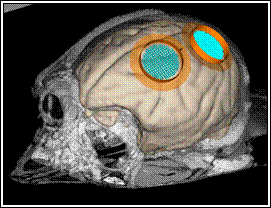
neural recordings in the premotor and parietal cortex, using two
semi-chronically implanted microdrives each with
32-96 independently moveable electrodes.
The affordance competition hypothesis
suggests that the brain can represent multiple potential actions in parallel
within the same regions involved in executing those actions during overt
behavior, and these parallel representations compete against each other during
decision-making. This competition is influenced by a variety of biases, such as
reward value and effort, and unfolds within a “sensorimotor map” that reflects
the geometry of the immediate environment. Our work with former student
Alexandre Pastor-Bernier confirmed two key predictions: 1) that reward values
influence activity in premotor cortex, but only when there is a choice to be
made; and 2) that the competition between two very different actions is
stronger than a competition between similar actions. In our newest project, led
by doctoral student Ayu no Nakahashi, we
are testing whether decisions are made by a “central executive” or through a
“distributed consensus” across the cortical network. This involves simultaneous
neural recordings in the premotor and parietal cortex, using two
semi-chronically implanted microdrives each with
32-96 independently moveable electrodes.
Cisek, P. & Kalaska, J.F. (2005) “Neural correlates of reaching decisions in dorsal premotor cortex: specification of multiple direction choices and final selection of action”. Neuron. 45(5): 801-814. [PDF]
Pastor-Bernier, A. and Cisek, P. (2011) “Neural correlates of biased competition in premotor cortex”. Journal of Neuroscience. 31(19): 7083-7088. [PDF] [suppl]
Pastor-Bernier, A., Tremblay, E., and Cisek, P. (2012) “Dorsal premotor cortex is involved in switching motor plans”. Frontiers in Neuroengineering. 5(5). doi: 10.3389/fneng.2012.00005. [PDF]
Cisek, P. (2012) “Making decisions through a distributed consensus”. Current Opinion in Neurobiology. 22(6): 927-936. [PDF]
“Urgency-gating
model”
 To
deal with a constantly changing world, the brain must quickly process sensory information
and make a variety of trade-offs between the speed of a decision and its
accuracy. Within the context of affordance competition, we hypothesize that the
process of deliberating between different action options takes places through a
competition occurring within the sensorimotor system (premotor and primary
motor cortex), combining three sources of information: Spatial information
about potential actions (from visual and parietal cortex); evidence in favor of
one action versus another (from prefrontal cortex); and a growing signal
related to the urge to make a movement (from the basal ganglia). When the
competition within these sensorimotor regions is resolved, the brain commits to
a choice and releases the selected movement. Former postdoc David Thura tested
predictions of this hypothesis through behavioral studies with humans, as well
as neural recordings in premotor, motor and prefrontal cortex as well as the
basal ganglia. New postdoc Tyler Peel is looking at how this process changes as
monkeys are still learning t he
decision-making task.
To
deal with a constantly changing world, the brain must quickly process sensory information
and make a variety of trade-offs between the speed of a decision and its
accuracy. Within the context of affordance competition, we hypothesize that the
process of deliberating between different action options takes places through a
competition occurring within the sensorimotor system (premotor and primary
motor cortex), combining three sources of information: Spatial information
about potential actions (from visual and parietal cortex); evidence in favor of
one action versus another (from prefrontal cortex); and a growing signal
related to the urge to make a movement (from the basal ganglia). When the
competition within these sensorimotor regions is resolved, the brain commits to
a choice and releases the selected movement. Former postdoc David Thura tested
predictions of this hypothesis through behavioral studies with humans, as well
as neural recordings in premotor, motor and prefrontal cortex as well as the
basal ganglia. New postdoc Tyler Peel is looking at how this process changes as
monkeys are still learning t he
decision-making task.
Thura, D., Cabana, J-F., Féghaly, A., and Cisek, P. (2022) “Integrated neural dynamics of sensorimotor decisions and actions” PLoS Biology. 20(12): e3001861. [PDF]
Thura, D. and Cisek, P. (2020) “Microstimulation of dorsal premotor and primary motor cortex delays the volitional commitment to an action choice” Journal of Neurophysiology. 123(3): 927-935.
Carland, M., Thura, D., and Cisek, P. (2019) “The urge to decide and act: Implications for brain function and dysfunction” The Neuroscientist. 25(5): 491-511. [PDF]
Thura, D., Guberman, G., and Cisek, P. (2017) “Trial-to-trial adjustments of speed-accuracy trade-offs in premotor and primary motor cortex” Journal of Neurophysiology. 117(2): 665-683. [PDF]
Thura, D. and Cisek, P. (2017) “The basal ganglia do not select reach targets but control the urgency of commitment”. Neuron. 95(5): 1160-1170. [PDF][suppl]
Carland M., Marcos, E., Thura, D., and Cisek, P. (2016) “Evidence against perfect integration of sensory information during perceptual decision-making” Journal of Neurophysiology. 115(2): 915-930. [PDF]
Thura, D. and Cisek, P. (2014) “Deliberation and commitment in the premotor and primary motor cortex during dynamic decision-making” Neuron. 81(6): 1401-1416. [PDF][suppl]
Thura, D., Beauregard-Racine, J., Fradet, C-W., and Cisek, P. (2012) “Decision-making by urgency-gating: Theory and experimental support” Journal of Neurophysiology. 108(11): 2912-30. [PDF]
Cisek, P., Puskas, G.A., and El-Murr, S. (2009) “Decisions in changing conditions: The urgency-gating model”. Journal of Neuroscience. 29(37): 11560-11571. [PDF]
“The biomechanics
of choices”
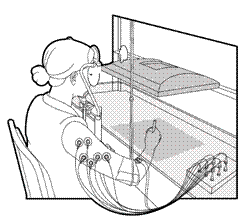 When
playing a sport, we are faced with a myriad of decisions between different
possible actions, and the best choice depends not only on potential outcomes
but also on the effort associated with each action. This project tests how
human subjects take the biomechanical costs of making different movements into
account when selecting between actions. It uses behavioral methods,
transcranial magnetic stimulation (TMS) to probe the evolving decision in the
human motor cortex, and (in collaboration with Andrea Green) galvanic
vestibular stimulation to test the influence of one’s body motion on their
action choices. Most recently, we’ve started looking at how decisions are made during
ongoing actions, and found that this challenges some of our assumptions…
When
playing a sport, we are faced with a myriad of decisions between different
possible actions, and the best choice depends not only on potential outcomes
but also on the effort associated with each action. This project tests how
human subjects take the biomechanical costs of making different movements into
account when selecting between actions. It uses behavioral methods,
transcranial magnetic stimulation (TMS) to probe the evolving decision in the
human motor cortex, and (in collaboration with Andrea Green) galvanic
vestibular stimulation to test the influence of one’s body motion on their
action choices. Most recently, we’ve started looking at how decisions are made during
ongoing actions, and found that this challenges some of our assumptions…
Cos,
Cos,
Cos,
Michalski, J., Green, A.M., Cisek, P. (2020) “Reaching decisions during ongoing actions” Journal of Neurophysiology. 123(3): 1090-1102. [PDF]
Current Lab Personnel:
Marie-Claude Labonté:
Laboratory technician
Tyler Peel: Postdoctoral fellow
Tyler is following up on our studies of the urgency-gating model, with simultaneous multielectrode recording in the prefrontal, premotor, and motor cortex, as well as the basal ganglia – even while monkeys are still learning the task.
Federica Bencivenga: Postdoctoral fellow (primary supervisor Andrea Green)
Federica is leading studies examining how the frontoparietal cortex selects, plans, and executes reaching movements while the body is moving through space.
Sujaya Neupane: Postdoctoral fellow (primary supervisor Jonathan Michaels, York University)
Sujaya is leading a project to develop methods for chronic recording using Neuropixel arrays.
Cesar Canaveral: Doctoral student (Co-supervisor: Andrea Green)
Cesar is following up on our studies of decisions during actions, introducing new task paradigms and additional approaches such as mechanical perturbations (using the KINARM) and transcranial magnetic stimulation.
Haoyang Li: Doctoral student
Haoyang’s project involves developing computational models that capture our data from neural recordings in monkeys.
William Tsafack: Master’s student
William’s project studies humans performing complex foraging tasks in virtual reality.
Alumni:
Alexandre Pastor-Bernier: PhD student 2007-2012, now postdoctoral fellow at McGill
Thomas Michelet: Postdoctoral fellow 2006-2008, now Team Leader at the Université de Bordeaux 2
Jean-Philippe Thivierge: Postdoctoral fellow 2006-2007, now an associate professor at the University of Ottawa
Valeriya Gritsenko: Research scientist 2008-2010, now associate professor at the University of West Virginia
Ignasi Cos: Postdoctoral fellow 2008-2012, now assistant professor at the University of Barcelona
David Thura: Postdoctoral fellow 2008-2018, now Group Leader at the Lyon Neuroscience Research Center
Tim Meehan: Postdoctoral fellow 2016-2018, now data scientist in New York City
Julien Michalski: Master’s student 2016-2020, now working in industry
Thomas Lusignan: Master’s student 2018-2021, now studying computer science
Matthew Carland: PhD student 2015-2020, now working in industry
Ayuno Nakahaski: PhD student 2015-2023, now postdoctoral fellow in Gottingen with Alexander Gail
Poune Mirzazadeh: Master’s student 2018-2021, now PhD student at York University with Jonathan Michaels
Geneviève Aude Puskas:
Undergraduate intern 2006
Elisabeth Rounis: Visiting
graduate student from London 2006
Stephany El-Murr:
Undergraduate intern 2007
Nicolas Bélanger:
Undergraduate intern 2009
Julie Beauregard-Racine:
Undergraduate intern 2009
Farid Medleg:
Visiting undergraduate intern from McGill, 2010
Charles-William Fradet:
Undergraduate intern 2010
Elsa Tremblay: Undergraduate
intern 2011
Jessica Trung:
Undergraduate intern 2013
Jean-François Cabana:
Undergraduate intern 2014
Albert Feghaly:
Undergraduate intern 2015
Guido Guberman: Visiting
undergraduate intern from McGill, 2015
Philippe Canstonguay:
Undergraduate intern 2016
Pierre-Éric Cazeau:
Undergraduate intern 2017
Thomas Lusignan:
Undergraduate intern 2018
Jia Dong Wang:
Undergraduate intern 2018
Sandra Ferland:
Undergraduate intern 2019
Léo Demange-Hamel:
Undergraduate intern 2021
Ikrame Housni:
Undergraduate intern 2021
William Lata: Undergraduate intern, summer 2022
Tianhui Deng: Undergraduate intern (McGill), summer 2022
Jacob Boulanger: Undergraduate intern, winter 2023
Louis-Philippe Tremblay: Undergraduate intern, summer 2023
Sasha Feradji: Undergraduate intern, summer 2024
Thomas Vanvoorden, visiting student from UC Louvain, spring & summer 2025
Flàvia Ferrús Marimón,
visiting student from U Barcelona, summer 2025
William Tsafack, Undergraduate intern, summer 2025
This page is permanently under construction. Last update was on January 29, 2026.